Upload a clear selfie and use GPT Image 2 to turn it into a playful ai age checker report card or an imaginative age timeline. Results are for entertainment only, never verification.

Generator examples

What an ai age checker report should show
A useful result makes the estimate easy to understand while also exposing its uncertainty. The large number is the entertaining part; the confidence and visual cues are reminders that the ai age checker is interpreting one photograph.
 12345
12345- 1Estimated age: a model-generated visual guess, not the person's known age.
- 2Confidence bar: useful for presentation, but not a calibrated scientific probability.
- 3Eyes and expression can change how an ai age checker interprets the same face.
- 4Jawline and camera angle affect the estimate even when the person is unchanged.
- 5Skin texture is heavily affected by lighting, makeup, filters, and compression.
01Use a front-facing photo in soft window light before running the ai age checker.
02Remove beauty filters; they can shift an ai age checker result more than real appearance.
03Run three generations and compare the range instead of believing one ai age checker number.
04Keep every ai age checker result private unless the person in the photo agrees to share it.
The age timeline is a creative preview, not a prediction
The second ai age checker mode imagines one identity at several life stages. It is useful for storytelling and character concepts, but no model can predict a real face decades into the future.
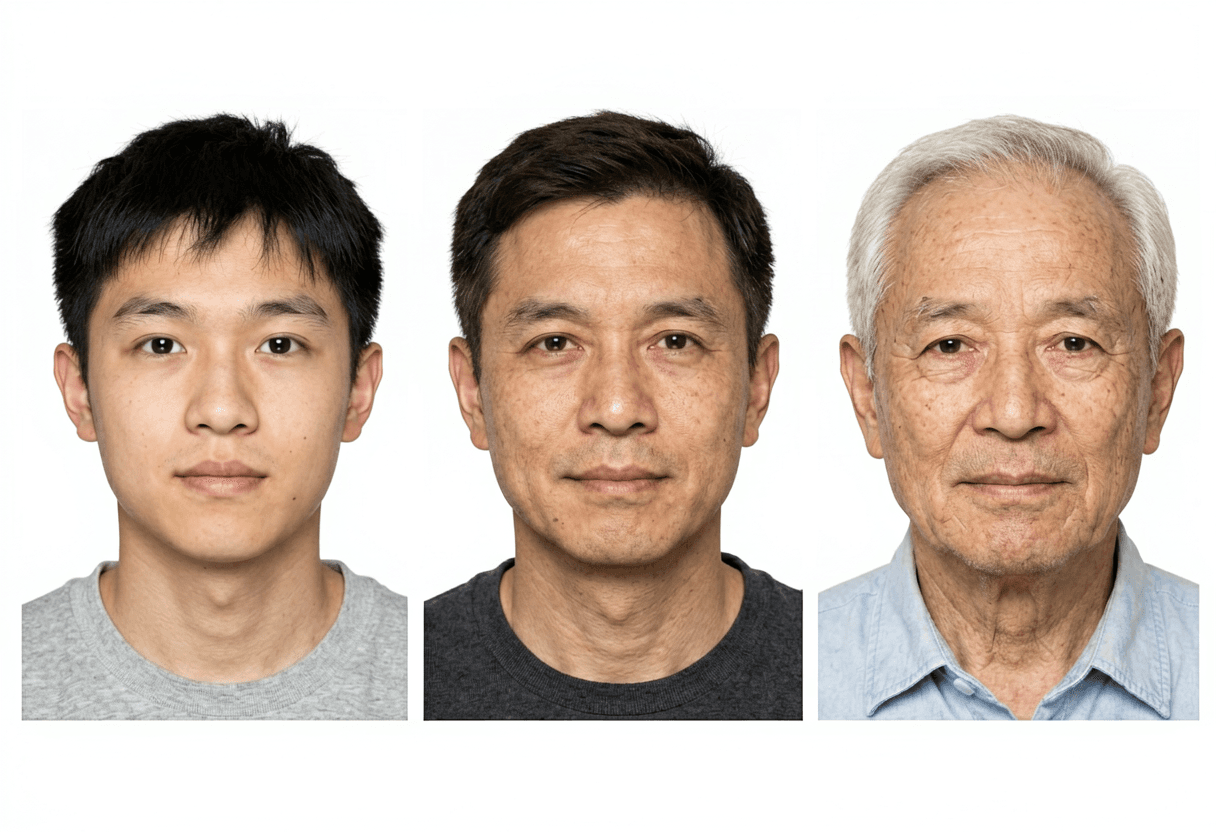
Identity consistency is the main quality test. A good ai age checker timeline keeps recognizable bone structure, eye shape, and expression while changing age cues such as hair, texture, and facial volume.
Real aging depends on genetics, environment, health, style, and life events that a photo cannot reveal. Treat every future panel as concept art, not a forecast.
Why the same selfie gets different ai age checker results
Before judging a number, inspect the photograph. These variables often move the output more than any real difference in age.
| Photo variable | What changes visually | Better test setup |
|---|---|---|
| Lighting | Harsh overhead light deepens shadows and texture, which can push an ai age checker older. | Use soft, even daylight from the front. |
| Camera angle | Low and wide phone angles change jaw and face proportions. | Hold the camera near eye level and step back. |
| Expression | Squinting, smiling, or tension changes visible lines around eyes and mouth. | Use one relaxed expression for comparisons. |
| Filters and makeup | Smoothing and contouring hide or invent cues the model may rely on. | Use an unfiltered image if you want a fairer experiment. |
| Compression | Tiny or heavily compressed photos erase fine detail and create artifacts. | Upload a sharp original rather than a screenshot. |
Use an ai age checker responsibly
The result is personal and uncertain. The right boundary is simple: use it for your own entertainment, never to judge or verify another person.
Do
- Ask permission before uploading someone else's image to an ai age checker.
- Describe every ai age checker result as an estimate or creative interpretation.
- Use the timeline mode for fictional characters, family storytelling, or visual concepts.
- Delete or avoid uploading sensitive images and identity documents.
Don't
- Do not use an ai age checker for legal age verification or access decisions.
- Do not use an ai age checker result in hiring, healthcare, insurance, or education decisions.
- Do not post another person's result as a joke without consent.
- Do not treat the confidence bar as a scientific probability.
12 useful and respectful ai age checker experiments
Keep the exercise transparent and consensual. These ideas focus on photography, storytelling, and model behavior rather than judging people.
- 01
Run the ai age checker on the same selfie under soft daylight and harsh overhead light, then compare the estimates.
- 02
Use an ai age checker on three camera angles to see how lens perspective changes the result.
- 03
Create an ai age checker report card for a fictional character portrait.
- 04
Make an ai age checker timeline for a novel protagonist at three life stages.
- 05
Compare an unfiltered image and a beauty-filtered image with the ai age checker.
- 06
Test whether smiling versus a neutral expression changes the ai age checker output.
- 07
Use the ai age checker timeline as concept art for a family-history presentation.
- 08
Create several ai age checker generations and chart the range rather than one number.
- 09
Compare a high-resolution portrait and a compressed screenshot in the ai age checker.
- 10
Use the ai age checker to discuss model uncertainty in a media-literacy lesson.
- 11
Create an ai age checker card for an original game or comic character.
- 12
Ask the ai age checker for a kind report with no score, only photography observations.
What the ai age checker cannot know
A photograph is a moment shaped by light, lens, expression, styling, and compression. The ai age checker sees only that visual surface. It cannot know the person's date of birth, health, genetics, lived experience, or how they appear in motion and natural conversation. That gap is why two honest photos of the same person can produce very different estimates.
Models also learn from imperfect image collections. Those collections can encode cultural, demographic, and photographic biases, which means an ai age checker may perform unevenly across different people. A polished report-card design does not remove that uncertainty. It only makes the output easier to read.
The most interesting use is therefore not asking whether the number is true. It is observing what changes the number. Testing lighting, angle, expression, and filters turns the ai age checker into a small lesson about photography and machine perception rather than a verdict about a face.
For identity-preserving photo edits, use Photo Retake AI. For a deliberately playful score-card format, see the AI Attractiveness Test, which carries similar consent and accuracy limits.
AI age checker — FAQ
What does an ai age checker actually measure?
An ai age checker looks at visible cues in a photo and produces an estimated age or an age-themed visual. It does not know a person's real age, health, biology, or identity. Voor presents the result as an entertainment image, not as a scientific or medical measurement.
Is an ai age checker accurate?
No ai age checker is consistently accurate. Lighting, camera angle, makeup, facial expression, image compression, and the model's own biases can move the estimate significantly. Treat the number as a playful opinion and never as evidence about a person.
How do I get a fairer ai age checker result?
Use a sharp front-facing portrait in soft natural light, remove heavy filters, and keep the expression relaxed. For a more honest experiment, run the same photo several times and compare the range instead of trusting one ai age checker number.
Can I use the ai age checker on someone else's photo?
Only use photos you have permission to edit. An ai age checker can feel personal, so avoid posting or sharing another person's result without their consent. Never use the result to mock, discriminate against, or make decisions about someone.
Does the ai age checker store my selfie?
Voor processes the image to create the requested output. Review Voor's privacy policy before uploading sensitive photos, and avoid using identity documents or images you would not want processed by an online service.
Can the ai age checker make an age progression?
Yes. Choose the Age timeline preset to create younger, current, and older interpretations of the same portrait. That output is imaginative rather than predictive; an ai age checker cannot know exactly how any real person will age.
Why did the ai age checker give different numbers for the same person?
Small visual changes strongly affect the estimate. A smile, harsh overhead light, a low camera angle, glasses, facial hair, or a beauty filter can all change what the ai age checker notices. Variation is expected and is another reason not to treat the number as fact.
Is the ai age checker suitable for medical or identity verification?
No. Do not use an ai age checker for healthcare, legal age verification, hiring, access control, or any decision that affects a person's rights. Use qualified professionals and approved verification systems for those purposes.
Is the ai age checker free?
New accounts receive 50 welcome credits. Use them for either the report-card or age-timeline preset, then purchase credits for reruns or comparisons.
People also search for
- ai age checker from photo
- ai age checker free online
- how old do i look ai
- ai age estimate report card
- ai age checker without login
- ai age progression from photo
- ai age checker accuracy
- ai age checker entertainment only
Use the ai age checker as a playful visual experiment, not a factual assessment. Upload only photos you have permission to use, compare several outputs, and keep the uncertainty visible.
Try a playful ai age checker report
Upload a clear portrait, choose report card or timeline, and treat the result as entertainment rather than verification.
Open the ai age checker